Any Questions? Email Us
Talk to an Expert
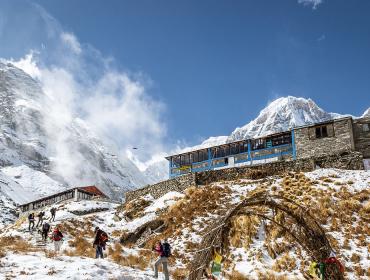
Everest High Passes Trek is an altitude thrilling journey in the Everest – Khumbu region, Nepal that includes trekking on popular Everest trails while also discovering unique gems of the Everest region.
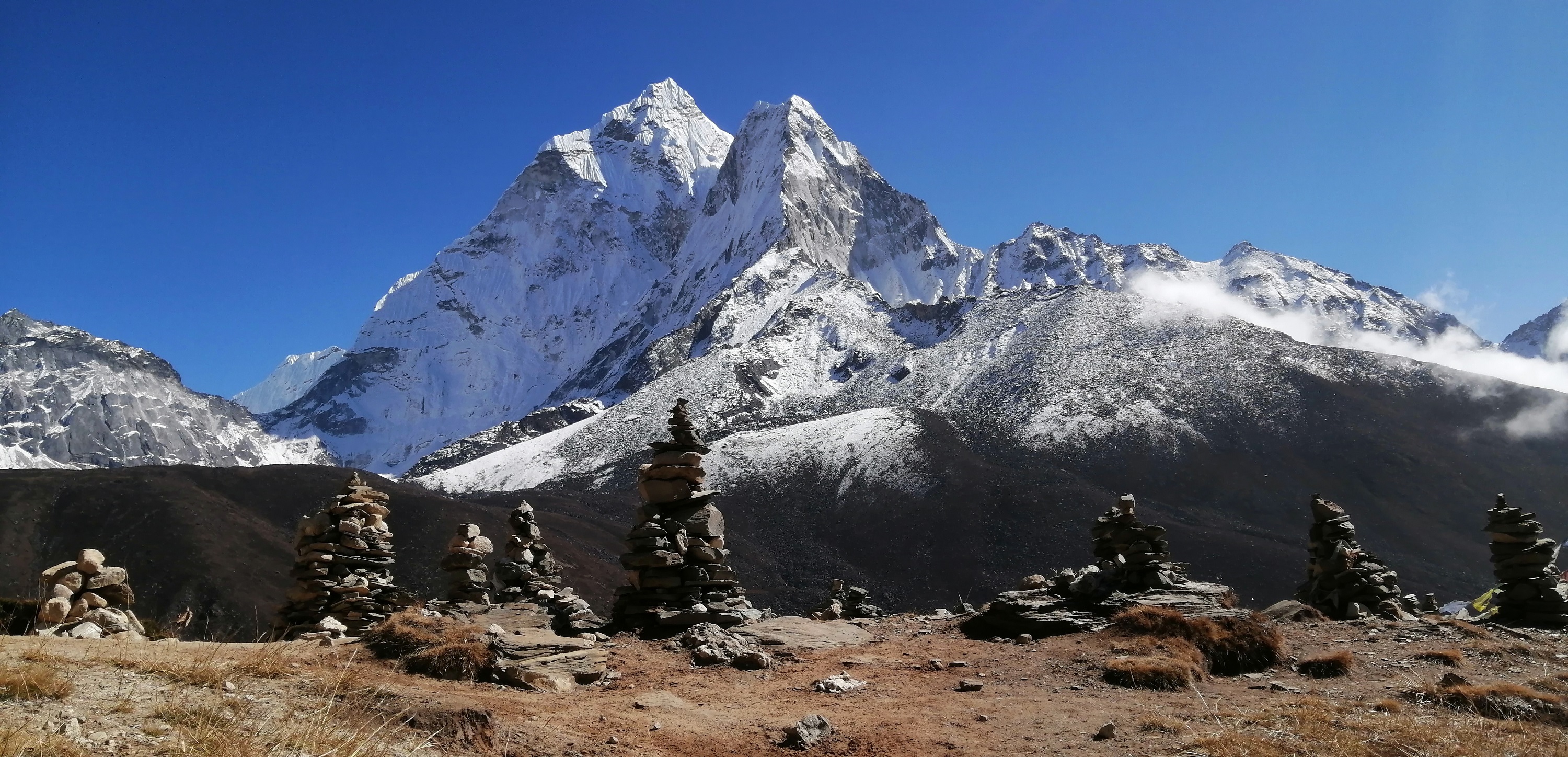
While trekking the Everest circuit, we cross three of the high passes of the Everest region viz. Kongma La, Cho La and Renjo La. The untouched villages and monasteries such as Marlung and Thame monastery will be introduced during this trek. We can say that this route takes in all the highlights of Khumbu such as cultural sites, amazing viewpoints, glaciers, and the iconic mountains in the world.
This journey will more than satisfy the ambitious trekker intent on crossing high passes without the commitment of any technical climbing. It will begin after a short flight to Lukla from Kathmandu. In the initial part of the trek, we follow the classic Everest Base Camp trek route till Dingboche. Taking right from Dingboche, we head towards Kongma La pass. Once we cross Kongma La, we descend to Lobuche and continue our trek to Everest Base Camp and Kala Patthar.
From Kala Patthar, we head back to Lobuche again and take the route of Dzongla, and the next day we cross Cho La and Thanngnak. Now the Gokyo valley is just 2 hours’ distance. Exploring Gokyo valley, Gokyo Lakes, and ascending to Gokyo Ri, we hike towards Renjo La pass, the easiest pass of the entire trek, and trek down to Lungden and Thame, before reaching Namche Bazaar, the largest Sherpa village of the entire Khumbu region. Trekking back to Lukla, we conclude our Everest High Passes Trek. Thus, If you are highly motivated and want to experience the absolute best of what the Everest region has to offer, then this is the trek for you.
Day 1: Kathmandu Arrival [1,338 m/4,390 ft]
Day 2: Flight Kathmandu [1,338 m/4,390 ft]to Lukla [2,860 m/9384 ft] and trek to Phakding [2,610 m/8,700 ft]
Day 3: Trek Phakding [2,610 m/8,700 ft] to Namche Bazaar [3,440 m/11,283ft]
Day 4: Acclimatization day at Namche Bazaar [3,440 m/11,283ft]
Day 5: Trek Namche Bazaar [3,440 m/11,283ft] to Tengboche [3860m/12660ft]
Day 6: Trek Tengboche [3860m/12660ft] to Dingboche [4,410m/14,464ft]
Day 7: Acclimatization Day at Dingboche [4410m/14464ft]
Day 8: Trek Dingboche [4410m/14464ft] to Chhukukng [4730m/15514ft]
Day 9: Trek Chhukung [4730m/15514ft] to Lobuche [4910m/16105ft] via Kongma La Pass [5535m/18160ft]
Day 10: Trek Lobuche [4910m/16105ft] to Everest Base Camp [5364m/17594ft] via Gorekshep [5,181m/16,994ft] and back to Gorekshep [5,181m/16,994ft]
Day 11: Hike to Kala Patthar [5,545m/18,188ft], back to Lobuche, and trek to Dzongla [4,830 m /15,939ft]
Day 12: Trek Dzongla to Thangnak [4,750 m/15,580ft] via Cho La [5420 m/17,780 ft]
Day 13: Trek Thangnak [4,750 m/15,580ft] to Gokyo Valley [4,800 m/15,744ft]
Day 14: An active Rest Day - Hike to Gokyo Ri [5360m/17586ft]
Day 15: Trek Gokyo Valley [4,800 m/15,744ft] to Lungden [4,500m / 14,764ft] via Renjo La [5360m/17580 ft]
Day 16: Trek Lungden [4,500m / 14,764ft] to Namche Bazaar [3,440 m/11,283ft]
Day 17: Trek Namche Bazaar [3,440 m/11,283ft] to Lukla [2,840 m/9,184 ft]
Day 18: Fly back to Kathmandu [1,350m/4,429ft] from Lukla [2,840 m/9,184 ft]
Day 19: Leisure day at Kathmandu – Sightseeing and Preparation for the final Departure
Day 20: Final Departure
Upon your arrival at Tribhuvan International Airport (TIA), you will be warmly welcomed by a representative from Outward Adventure Treks. After completing immigration formalities, you will be transferred to your hotel in the heart of Kathmandu. The vibrant streets of Thamel offer a perfect introduction to Nepal’s rich culture, with bustling markets, traditional restaurants, and ancient temples.
In the evening, you will meet your trekking guide for a briefing session, where they will explain the itinerary, check your gear, and answer any questions. You’ll also receive your trekking permits (Sagarmatha National Park Permit and Khumbu Pasang Lhamu Rural Municipality Permit). The rest of the day is free for you to explore Kathmandu’s UNESCO World Heritage Sites, such as Swayambhunath (Monkey Temple) or Boudhanath Stupa, or simply relax at the hotel.
Dinner will be served at a traditional Nepali restaurant, where you can enjoy authentic dishes like dal bhat (lentil soup with rice), momo (dumplings), and Newari cuisine. Overnight stay in Kathmandu to prepare for your early morning flight to Lukla the next day.
An early morning scenic flight from Kathmandu to Lukla (about 35 minutes) offers breathtaking views of the Himalayas, including Mt. Everest, Lhotse, and Nuptse. The thrilling landing at Tenzing-Hillary Airport, one of the world’s most dangerous airstrips, marks the start of your adventure. After meeting your porters and having breakfast in Lukla, you begin your trek towards Phakding, a gentle 3-4 hour walk.
The trail descends through lush green valleys, passing traditional Sherpa villages, prayer wheels, and suspension bridges over the Dudh Koshi River. You’ll encounter fellow trekkers, yaks, and mule caravans carrying supplies. Phakding is a charming village with cozy teahouses, where you can relax and enjoy the serene mountain atmosphere.
After checking into your lodge, you can explore the village or take a short walk to a nearby monastery. The evening is spent acclimatizing, enjoying warm meals, and preparing for the next day’s hike to Namche Bazaar. Overnight in Phakding.
Today’s trek is one of the most challenging yet rewarding, as you enter the Sagarmatha National Park and ascend towards Namche Bazaar, the gateway to Everest. The trail crosses several suspension bridges, including the famous Hillary Bridge, before a steep climb to Namche. Along the way, you’ll catch your first glimpse of Mt. Everest (weather permitting).
After about 5-6 hours of trekking, you’ll reach Namche, a bustling Sherpa town with shops, bakeries, and internet cafes. This vibrant hub is the last major settlement before reaching higher altitudes. Upon arrival, you’ll check into a comfortable lodge, where you can enjoy hot showers and delicious meals like garlic soup (helps with acclimatization).
The evening is free to explore Namche’s markets or visit the Sherpa Culture Museum to learn about local traditions. A good night’s rest is essential to prepare for the next day’s acclimatization hike. Overnight in Namche Bazaar.
Acclimatization is crucial for a safe and successful trek, so today you’ll take a short hike to Everest View Hotel (3,880 m), one of the highest-placed hotels in the world. The trail offers panoramic views of Everest, Lhotse, Ama Dablam, and Thamserku. You’ll also visit Khumjung Village, home to the famous Hillary School and a yeti scalp at the local monastery.
After returning to Namche, you’ll have free time to explore the town further, buy last-minute trekking gear, or relax with a cup of coffee at a bakery. Your guide will brief you on the next day’s trek to Tengboche, ensuring you’re well-prepared for higher altitudes.
In the evening, you can enjoy a hearty meal and mingle with fellow trekkers. Proper hydration and rest are key to avoiding altitude sickness. Overnight in Namche Bazaar.
The trek from Namche Bazaar to Tengboche is one of the most scenic routes in the Everest region, offering uninterrupted views of the Himalayan giants. The trail begins with a gentle climb out of Namche, passing through fragrant rhododendron and pine forests, with occasional glimpses of Ama Dablam’s towering peak. As you walk, the path opens up to sweeping vistas of Everest, Lhotse, and Nuptse, standing majestically against the deep blue sky. The descent to the Dudh Koshi River is steep but rewarding, as you cross a picturesque suspension bridge before beginning the final ascent to Tengboche.
Upon reaching Tengboche, you’ll be greeted by the famous Tengboche Monastery, the largest in the Khumbu region. This spiritual sanctuary is a center of Sherpa Buddhism, and if you’re lucky, you might witness monks chanting during evening prayers. The monastery’s hilltop location provides a 360-degree panorama of the Himalayas, making it an ideal spot for photography. The surrounding landscape is serene, with prayer flags fluttering in the wind and the distant sound of yak bells adding to the mystical atmosphere.
You’ll spend the night in a cozy lodge, enjoying warm meals like Sherpa stew or Tibetan bread. The temperatures drop significantly at this altitude, so bundling up is essential. Before bed, take a moment to step outside and gaze at the starry sky, unpolluted and dazzling at this elevation. The combination of spiritual energy and natural beauty makes Tengboche a highlight of the trek.
Leaving Tengboche, the trail descends through a lush forest of birch and conifer trees, with the Imja Khola (river) murmuring alongside. The path then gradually climbs towards Pangboche, a traditional Sherpa village where you can visit the oldest monastery in the region, said to house a yeti scalp. The locals here still follow age-old farming practices, and you might see them tending to their potato fields or herding yaks. Beyond Pangboche, the landscape becomes more arid, with rocky moraines and sparse vegetation signaling your approach to higher altitudes.
As you ascend further, the views of Ama Dablam become even more dramatic, its icy flanks glistening in the sunlight. The trail winds through stone-walled fields and small settlements, where hardy Sherpa families live year-round. The final stretch to Dingboche is a steady climb, and the thinning air makes each step more challenging. However, the sight of the Imja Valley opening up before you—with its patchwork of fields and towering peaks—is a breathtaking reward for your efforts.
Dingboche is a picturesque village nestled in a high-altitude valley, surrounded by snow-capped mountains and rugged cliffs. Upon arrival, you’ll check into a teahouse and enjoy a warm drink while soaking in the views. Since you’ve now crossed the 4,000-meter mark, acclimatization is critical. Spend the afternoon resting, hydrating, and taking short walks to help your body adjust. The evening is peaceful, with the mountains glowing in the golden light of sunset—a perfect end to a fulfilling day.
Acclimatization at Dingboche is essential to prepare your body for the even higher altitudes ahead. After a leisurely breakfast, you’ll embark on a short but steep hike to Nagarjun Hill (5,100 m), which offers unparalleled views of Makalu, Lhotse, and the Imja Valley. This hike is not just about sightseeing—it’s a "climb high, sleep low" strategy that helps your body adapt to reduced oxygen levels. The ascent is challenging, but the panoramic vista from the top makes every step worthwhile. On a clear day, you can even see the distant peak of Cho Oyu, the sixth-highest mountain in the world.
After descending back to Dingboche, the rest of the day is yours to relax and explore the village. You can visit local bakeries for freshly baked apple pie or browse small shops for souvenirs. Another option is to take a gentle walk along the valley floor, observing the ancient mani walls (stone tablets inscribed with Buddhist prayers) and the resilient barley fields that thrive in this harsh climate. The slower pace allows you to appreciate the subtle beauty of high-mountain life.
In the evening, your guide will brief you on the next leg of the journey—the trek to Chhukung and the ascent over Kongma La Pass. This is a good time to check your gear, especially warm layers and trekking poles, as the upcoming days will be more demanding. A hearty dinner and early bedtime will ensure you’re well-rested for the adventure ahead. Overnight in Dingboche.
Today’s trek is relatively short but takes you deeper into the high-altitude wilderness of the Khumbu. The trail follows the Imja Valley, gradually ascending past glacial streams and moraines, with the massive Lhotse South Face looming overhead. The air grows thinner, and the landscape becomes more lunar-like, with scattered boulders and patches of hardy alpine grass. Chhukung is a small settlement, but its location makes it a crucial stop before tackling the Kongma La Pass—the first of the three high passes on your journey.
Upon reaching Chhukung, you’ll check into a basic but welcoming teahouse. The village is surrounded by glacial peaks and offers stunning views of Island Peak (6,189 m), a popular trekking peak for climbers. If you’re feeling energetic, you can take an optional hike to Chhukung Ri (5,546 m), a lesser-known viewpoint that provides a 360-degree panorama of the Everest range. This side trip is excellent for further acclimatization and photography, but it requires steady footing as the trail is rocky and steep.
The evening is spent preparing for the challenging crossing of Kongma La Pass tomorrow. Your guide will go over the route, emphasizing the importance of an early start and proper layering for changing weather conditions. Dinner will likely include carb-heavy dishes like pasta or potatoes to fuel your energy reserves. As you settle in for the night, the silence of the mountains is profound—broken only by the occasional rumble of distant avalanches. Overnight in Chhukung.
Today marks one of the most demanding yet exhilarating days of your trek—crossing the formidable Kongma La Pass (5,535m), the highest of the Three Passes. You’ll start before dawn, headlamps cutting through the icy darkness as you begin the steep, rocky ascent. The trail is rugged, weaving through moraines and over loose scree, requiring careful footing. As the sun rises, it paints the surrounding peaks—Nuptse, Ama Dablam, and the jagged spine of the Mahalangur Himal—in fiery hues. The final push to the pass is grueling, but the moment you reach the summit, the panoramic view of the Khumbu Glacier and a sea of 8,000m giants will leave you breathless (and not just from the altitude).
After celebrating with photos and a quick snack, the descent begins—a mix of sliding down loose gravel and navigating icy patches before reaching the Khumbu Glacier’s lateral moraine. The trail then joins the main Everest route, where you’ll encounter trekkers returning from Base Camp. The last stretch to Lobuche is a gentle climb past memorials for climbers lost on Everest, a sobering reminder of the mountains’ power. By afternoon, you’ll collapse into a teahouse, exhausted but triumphant, sipping ginger tea as your legs protest. The evening is spent swapping stories with fellow trekkers, everyone buzzing with the shared achievement of conquering Kongma La.
The air is thin, and every step feels heavier as you set out for Everest Base Camp (EBC), following the rocky trail alongside the Khumbu Glacier. The path winds through a surreal, almost lunar landscape—crumbling moraines, ice seracs, and the distant roar of avalanches echoing off the valley walls. After 2–3 hours, you reach Gorak Shep, a windswept outpost with a few basic lodges. Dropping your bags, you fuel up on noodles or chocolate bars before the final push to EBC.
The last hour to Base Camp is slow-going, with the glacier’s uneven terrain demanding full attention. And then—you’re there. The iconic yellow tents of expedition teams dot the ice, prayer flags flutter in the wind, and the Khumbu Icefall looms ominously ahead, a maze of crevasses that climbers must navigate. It’s humbling to stand where legends like Hillary and Norgay once prepared for their summit bids. After soaking in the moment (and snapping a hundred photos), you retrace your steps to Gorak Shep, legs wobbly but spirits high. That night, you sleep at 5,181m, the thin air making even rolling over in bed feel like a workout.
You wake at 4 AM, groggy but determined, and begin the steep, dark climb to Kala Patthar. The cold bites through your layers as you scramble over rocks, guided by the glow of headlamps. Just as exhaustion threatens to win, you crest the summit—and the world explodes into color. The first light of dawn strikes Everest’s summit pyramid, turning it gold, while the surrounding peaks—Pumori, Lingtren, and Changtse—glow in alpenglow. It’s the closest you’ll ever get to Everest without crampons, and the view is soul-stirring.
Back in Gorak Shep, you devour breakfast before descending to Lobuche, where you’ll turn off the main trail toward Dzongla. This quiet, high-altitude hamlet sits beneath the Cholatse’s dramatic face, its turquoise glacial lake shimmering in the afternoon light. The walk is short but surreal, with yaks grazing in meadows that feel untouched by time. That evening, you rest early, knowing tomorrow brings the treacherous Cho La Pass. As you drift off, the distant rumble of icefalls reminds you: the mountains decide who passes.
The morning begins in darkness, your headlamp cutting through the cold as you start the grueling ascent toward Cho La Pass. The initial trail winds through boulder fields, each step requiring careful placement to avoid twisting an ankle. As dawn breaks, you reach the glacier's edge, where your guide helps secure microspikes to your boots - the ice glistens treacherously under the morning sun. The final push to the pass is a heart-pounding scramble, your lungs burning in the thin air, but the moment you crest the ridge, the Ngozumpa Glacier unfolds below like a frozen sea, with the towering peaks of the Gokyo Valley framing the horizon.
Descending the western side proves just as challenging, with steep snowfields giving way to loose scree that sends small avalanches of pebbles skittering ahead of you. The trail eventually levels out near a series of turquoise glacial ponds, where you stop to refuel with chocolate and nuts. The last hour to Thangnak feels endless, your knees protesting each downhill step, but the sight of the village's stone-walled lodges nestled beneath Cholatse's sheer face revives your spirits.
Arriving in Thangnak feels like reaching an oasis. The tiny settlement consists of just a few lodges, but the warm welcome from the Sherpa family running your teahouse makes it feel like home. As you sip garlic soup (a proven remedy for altitude sickness), you watch the afternoon light paint the surrounding peaks gold. The evening is spent swapping stories with other trekkers who've conquered the pass, everyone's faces still flushed with the day's exertion. Before an early bedtime, you step outside to see the stars blazing impossibly bright in the thin Himalayan air, the glacier murmuring in the distance.
Morning light reveals the stunning path ahead as you set out along the Ngozumpa Glacier, the longest glacier in the Himalayas. The trail weaves between moraine hills and past startlingly blue meltwater ponds, their surfaces so still they perfectly mirror the surrounding peaks. Yaks plod along carrying supplies, their bells creating a rhythmic soundtrack to your hike. As you round a bend, the first Gokyo Lake appears like a sapphire set in stone, its color so vibrant it seems unreal against the stark mountain backdrop.
By midday, you reach the second lake, where you pause to eat lunch on its shores, skipping stones across the glassy surface. The final approach to Gokyo village takes you past the third and largest lake, where prayer flags flutter in the breeze and the massive bulk of Cho Oyu (8,188m) dominates the northern skyline. The village itself clings to the lakeshore, its stone lodges offering stunning views from every window. After checking in, you wander down to the water's edge, where the reflection of Mt. Gangchen Ta (6,387m) creates a perfect symmetrical world.
The afternoon is yours to explore - perhaps visiting the small bakery for fresh apple pie or climbing a nearby hill for better photos. As sunset approaches, the mountains transform through shades of pink and purple, their reflections doubling the spectacle in the calm lake waters. That evening, bundled in your lodge's common room, you enjoy a celebratory dinner of dal bhat while planning tomorrow's pre-dawn hike to Gokyo Ri. The excitement is palpable - you're now deep in the heart of the high Himalayas, surrounded by some of Earth's most breathtaking scenery.
The 4-4:30 AM alarm comes too soon, but the promise of sunrise from Gokyo Ri gets you moving. By headlamp light, you begin the steep switchbacks leading up the mountain's flank, your breath forming clouds in the freezing air. As you climb higher, the darkness gradually lifts, revealing the Gokyo Lakes below like scattered pieces of sky. The final ascent is punishing - at this altitude, every step requires three breaths - but reaching the summit before dawn makes it all worthwhile. As the first rays strike Everest's summit pyramid 30km away, the entire Himalayan range ignites in golden light, from Makalu to Cho Oyu, a 360-degree panorama of the world's highest peaks.
Spending nearly an hour on the summit, you alternate between photography and silent awe, watching as the morning light creeps down the mountainsides. The descent is joyful, the daytime views even more spectacular than the dawn approach. Back in Gokyo by mid-morning, you treat yourself to a second breakfast of pancakes and honey, your legs pleasantly tired. The lodge's sunny porch becomes your base for the day, where you write postcards, sort photos, and doze in the high-altitude sunshine, the lake's surface rippling in the breeze.
This "rest day" activity proves the perfect balance between challenge and recovery. In the afternoon, you take a leisurely walk along the lakeshore, visiting the small monastery where butter lamps flicker in the dim interior. As evening falls, you join other trekkers to watch the sunset from the village's edge, the mountains turning fiery red before fading to indigo. Tomorrow brings the final high pass - Renjo La - but for now, you savor this moment of perfect mountain peace, knowing such experiences are rare and precious.
The trail to Renjo La begins quietly, winding past the fourth and fifth Gokyo Lakes as the village disappears behind you. Unlike the busier Kongma and Cho La passes, Renjo La offers solitude - for hours, you might see no one but your team. The climb starts gently through a valley dotted with grazing blue sheep, then turns steep as you approach the pass's towering headwall. The final 300 meters are the most challenging, zigzagging up loose scree where you slide back half a step for every one gained. But cresting the pass rewards you with what many consider the best view in the Everest region - the entire Gokyo lake system spread below, with Everest and Lhotse rising majestically beyond.
The descent into the Rolwaling Valley side feels like entering another world. The trail drops past ancient mani walls and through remote summer pastures where nomadic herders tend their yaks. You cross glacial streams on wobbly stone bridges, the landscape growing greener with each descending kilometer. By late afternoon, the isolated settlement of Lungden appears, its few lodges clinging to the mountainside above a rushing river. The tiny village sees few trekkers, offering an authentic glimpse of high Himalayan life unchanged for generations.
Your lodge in Lungden is basic but welcoming, the kitchen produces surprisingly good pizza from a wood-fired oven. As you eat, the lodge owner shares stories of expeditions past, his face lit by the flickering stove fire. Outside, the stars emerge with shocking clarity, the Milky Way stretching across the valley like a luminous river. This peaceful night marks the end of your high pass crossings - tomorrow begins the long return journey to Namche, but for now, you savor the quiet majesty of this hidden valley.
The morning trail follows the Bhote Koshi River downstream, leading you out of the high wilderness and back toward more inhabited valleys. After days of rugged terrain, walking on a gently descending path feels like a gift, your stride lengthening as the air grows thicker with oxygen. You pass through Thame, an important Sherpa village with an ancient monastery, where you stop for tea and to watch locals going about their daily lives - children heading to school, women weaving, men repairing stone fences. The contrast with the empty landscapes of the past week is striking.
By midday, you rejoin the main Everest trail near Samde, where the sudden appearance of other trekkers feels almost jarring. The final descent to Namche winds through fragrant pine forests, the trail wide and well-maintained after the rugged passes. When Namche Bazaar finally comes into view - its colorful buildings terraced into the hillside - it feels like returning to a metropolis after weeks in the wilderness. Checking into the same lodge where you acclimatized days before creates a satisfying sense of coming full circle.
The afternoon in Namche is a blur of small pleasures - a long shower, fresh pastries from the German bakery, souvenir shopping for family back home. That evening, gathered around a table with fellow trekkers, the conversation turns to the incredible journey behind you. Over plates of yak steak and bottles of Everest beer, you trade stories about the passes, the close calls, and the moments of transcendent beauty. The warmth of the dining room, the laughter, and the knowledge that your toughest days are behind you create a glow that rivals any mountain sunrise.
The final trekking day begins with a nostalgic descent along the Dudh Koshi River, retracing your very first steps from weeks ago. The suspension bridges that once felt thrilling now seem familiar, though no less spectacular. Passing through Phakding, you stop at the same teahouse where you had your first lunch on the trail, the owner recognizing you with a smile. The forested valleys feel almost tropical after the high alpine zones, the air rich with the scent of blooming rhododendrons. Porters bound for Namche with towering loads give you knowing nods - you've earned your place on this trail.
The final climb to Lukla arrives cruelly at day's end, a steep two-hour ascent that tests tired legs. But reaching the town's outskirts brings a surge of emotion - you've come full circle, back to where your adventure began. The noisy, bustling streets of Lukla feel worlds away from the silent heights of the passes, with planes roaring overhead and trekkers celebrating their journeys' ends. Checking into your lodge, you lay out your gear to dry one last time, the ritual now bittersweet.
That night, the whole team gathers for a farewell celebration - guides, porters, and trekkers sharing food, drinks, and heartfelt toasts. The Sherpa staff present traditional khata scarves, their kindness over these weeks moving you deeply. As the party winds down, you step outside to see the mountains one last time, their silhouettes black against the starry sky. The knowledge that tomorrow you'll fly back to Kathmandu fills you with equal parts relief and longing - ready for comfort, but not ready to say goodbye.
The early morning at Lukla Airport is all nervous energy, with trekkers watching the sky for weather updates. When your plane finally boards, the 35-minute flight becomes a visual recap of your journey - the terraced hillsides giving way to urban sprawl as you approach Kathmandu. Touching down at Tribhuvan International Airport feels surreal, the noise and chaos of the city overwhelming after weeks in the mountains. Your transfer to the hotel is a blur, the sights and smells of Kathmandu rushing past in a colorful stream.
Checking into a comfortable hotel, your first real shower in weeks feels like a spiritual experience, the hot water washing away layers of dust and sweat. Wearing clean clothes for the first time in ages, you marvel at how light your daypack feels without all the gear. The afternoon is for simple pleasures - proper coffee, emails home, maybe a massage for your aching muscles. Strolling through Thamel's vibrant streets, you find yourself instinctively walking at "trekking pace," smiling at other returned hikers by their distinctive gait.
Waking without an alarm for the first time in weeks feels luxurious, as does a leisurely breakfast with fresh fruit and real coffee. The day is yours to explore Kathmandu's cultural treasures - perhaps visiting the ancient city of Bhaktapur, where medieval temples rise above brick-paved streets, or the Buddhist stupa at Boudhanath, its all-seeing eyes watching over circling pilgrims. Everywhere you go, glimpses of the Himalayas tease from between buildings, keeping the connection alive.
In Thamel's shops, you pick up last-minute souvenirs - handmade paper journals, singing bowls, or a thangka painting to commemorate your journey. At lunch, you find yourself craving dal bhat, the trekking staple that fueled your days in the mountains. The afternoon might include a visit to Pashupatinath Temple, where Hindu cremation ceremonies along the Bagmati River offer perspective on life's cycles, or simply relaxing at a rooftop café, watching the city bustle below.
That evening, gathered with your team for a farewell dinner, the conversation keeps returning to the mountains - the challenges faced, the beauty witnessed, the bonds formed. Over plates of momos and glasses of raksi, you realize these shared experiences have become part of you. Back in your room, packing your gear for the final time, you run your fingers over your well-worn boots, already knowing this won't be your last Himalayan adventure.
Morning light filters through your hotel window as you pack your bags one last time, carefully wrapping fragile souvenirs between soft clothing. At breakfast, you exchange contact information with trek mates, promising to share photos and stay in touch. The ride to the airport is quiet, each of you lost in reflection as Kathmandu's colorful chaos streams past the windows.
One of the representatives from Outward Adventure Treks and Expedition will take you to the airport at least three hours before your scheduled flight. At the airport, final goodbyes with your guide and team are heartfelt - these people who kept you safe and shared their mountain world. As your plane lifts off, you press your face to the window, hoping for one last glimpse of the Himalayas. Whether visible or not, you know they're there, just as you know part of you will always remain among those high passes and hidden valleys.
Transportation
Accommodation and Food
Staff
Permits and Taxes
Extra
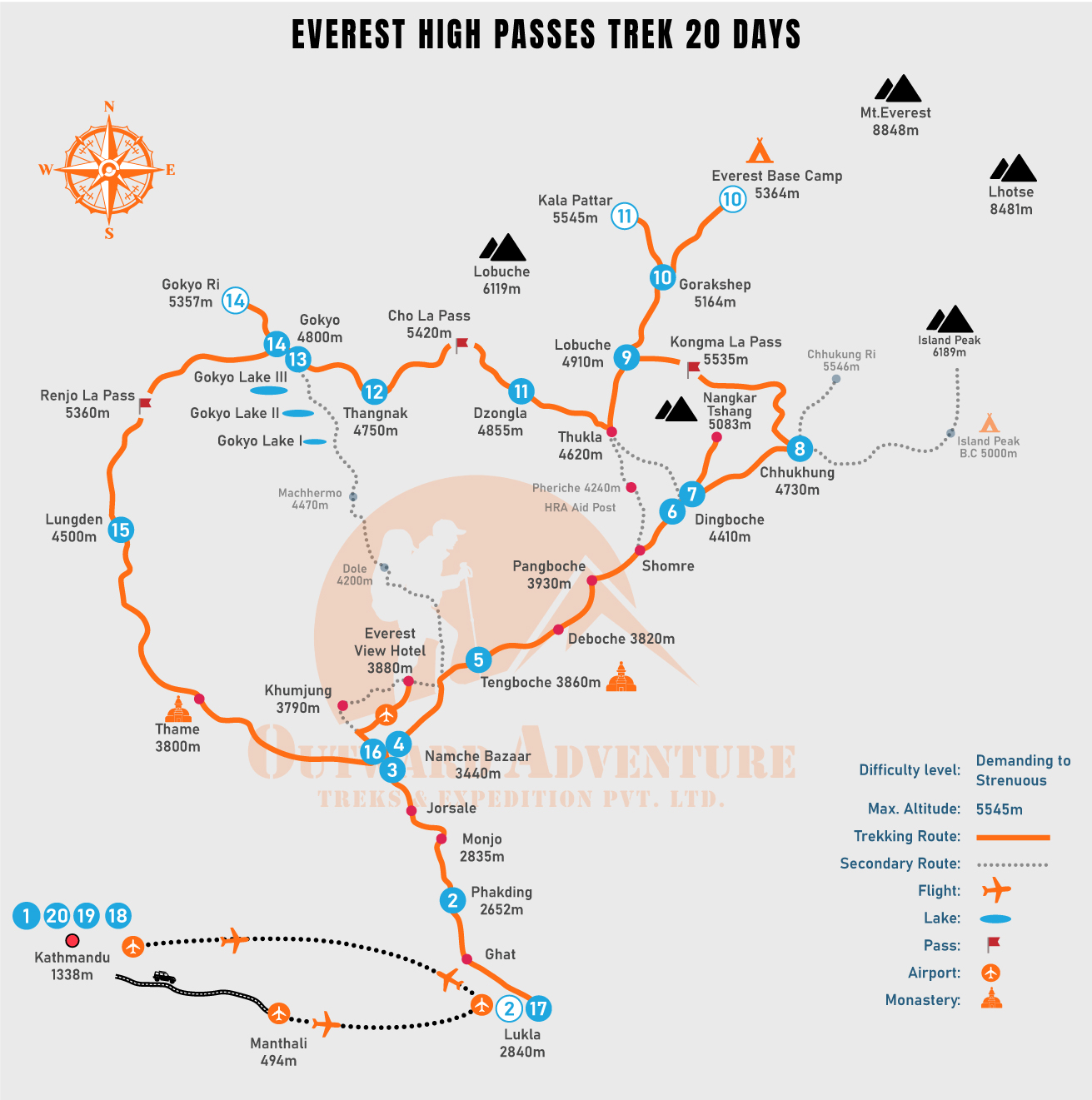
During the peak summit hours or busy trekking seasons —Spring and Autumn (March, April, May, October, and November) —most flights to and from Lukla are operated from Ramechhap (Manthali) airport rather than Kathmandu airport due to heavy air traffic congestion.
For that, travelers have two options: either move to Ramechhap earlier in the day, or start the journey around 12:30 am to catch the morning flight, as it is a five-hour drive from Kathmandu. So that you can fly to Lukla and start your trek. In other months, the flights are normally conducted from Kathmandu airport itself.
And, it is common to have weather-related delays on the Lukla route; you are recommended to add at least two extra days to your schedule to avoid missing your international flight.