Any Questions? Email Us
Talk to an Expert

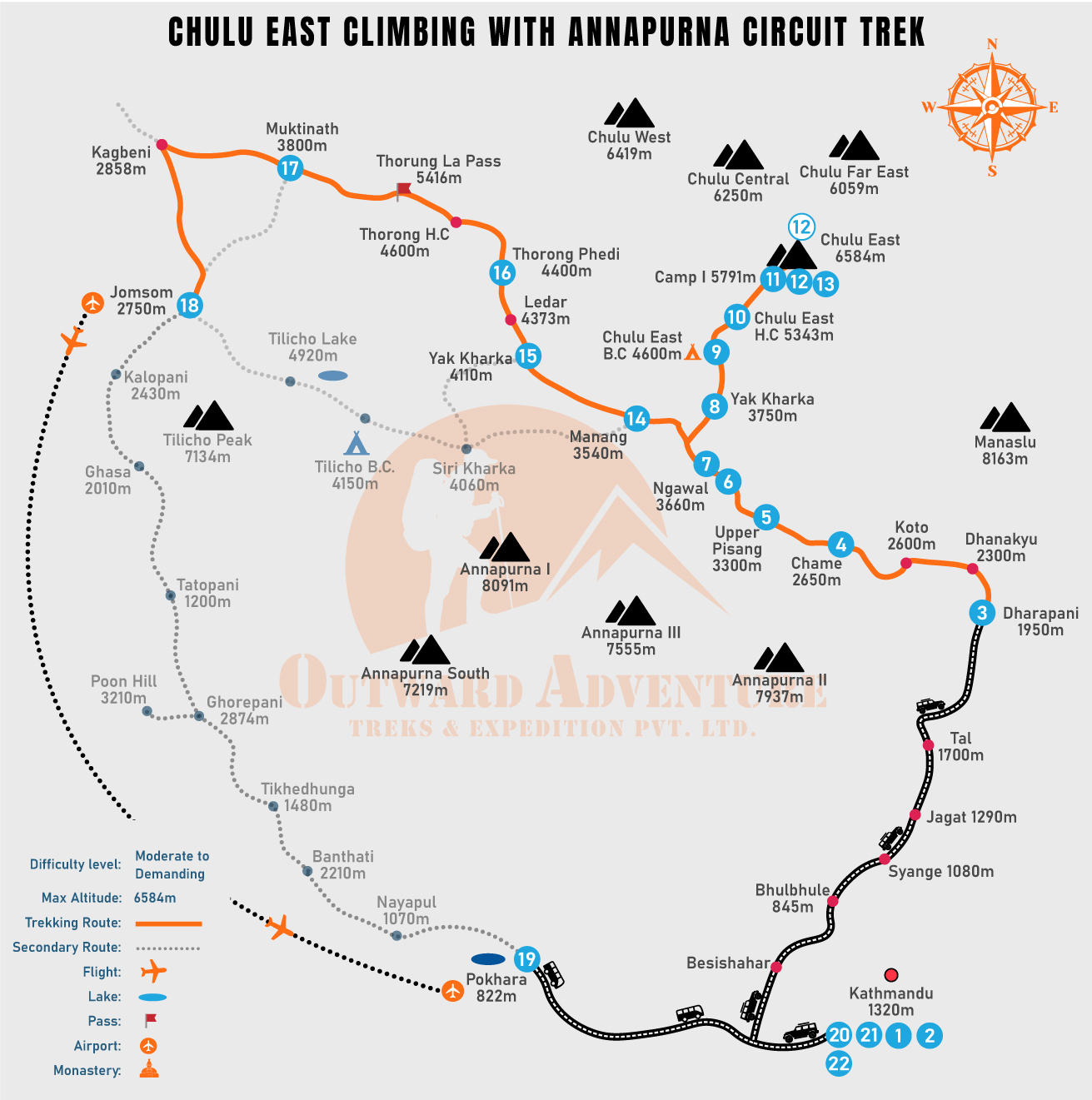
Chulu East Peak Climbing is a thrilling adventure that combines the iconic Annapurna Circuit Trek with the challenge of summiting a 6,584-meter peak. This expedition offers a unique opportunity to immerse yourself in the breathtaking landscapes and diverse cultures of the Annapurna region while pushing your mountaineering skills to new heights. The trek begins in the subtropical lower valley, where you'll witness terraced fields and villages inhabited by ethnic Gurungs. As you ascend through rhododendron and pine forests, you'll reach the high-altitude realm of the Manangba people.
At Pisang, you'll depart from the Annapurna Circuit Trail and venture into uninhabited terrain, following a ridge adorned with pine forests, yak pastures, and ancient mani walls to reach the Chulu East Base Camp. Proper acclimatization is crucial, and you'll spend two nights at the base camp, allowing your body to adjust to the altitude.
Meanwhile, your experienced climbing guides and Sherpa team will establish high camps and Camp I, preparing for the final push to the summit. The climb itself is challenging, with long days of walking on snow, especially on summit day. However, the rewards are immense. From the summit of Chulu East Peak, you'll be treated to breathtaking views of the Annapurna massif, including Annapurna II, III, and IV, Gangapurna, Glacier Dome, Dhaulagiri, Tilicho Peak, and Manaslu.
The Chulu East Peak Climbing expedition is a true test of endurance and determination, but the journey is equally fascinating. As you descend, you'll pass through diverse ecosystems, from lush, green paddy fields and oak forests to arid deserts and the deepest gorge. The exposure to the variety of cultures and landscapes makes this adventure truly unmatched.
It's important to note that while Chulu East Peak is considered a moderate trekking peak, it still requires previous mountaineering experience and the ability to use essential equipment such as crampons, harnesses, and ice axes. The summit day can be long and demanding, so a high level of physical fitness and mental commitment is necessary. The best seasons for climbing Chulu East Peak are spring (March to May) and autumn (September to November), when weather conditions are generally favorable. However, winter can also be a great time to climb if you are well-prepared for the cold weather.
Overall, Chulu East Peak Climbing with the Annapurna Circuit Trek is a once-in-a-lifetime adventure that combines the thrill of mountaineering with the beauty of trekking through one of the most stunning regions in the world. Whether you are an experienced climber or a passionate trekker, this expedition is sure to leave an indelible mark on your heart and mind.
Day 1: Arrival in Kathmandu (1300 m/4265 ft
Day 2: Exploring Day in Kathmandu / Trip Preparation Day
Day 3: Drive Kathmandu to Dharapani (1946 m / 6383 ft) via Bensisahar: 9 to 10 hrs.
Day 4: Trek Dharapani to Chame (2670 m/8758 ft): 5 to 6 hrs.
Day 5: Trek Chame to Pisang (3200 m/10497 ft): 5 to 6 hrs.
Day 6: Trek Pisang to Ngawal (3660 m/120078 ft): 5 to 6 hrs.
Day 7: Rest Day at Ngawal / Acclimatize Hike Around
Day 8: Trek Nagwal to Yak Kharka (3750 m/12301 ft): 5 to 6 hrs.
Day 9: Trek Yak Kharka to Chulu East Base Camp (4600 m/15091 ft): 5 hrs.
Day 10: Trek Chulu East Base Camp to Chulu East High Camp (5343 m/17,500 ft): 3 to 4 hrs.
Day 11: Trek Chulu East High Camp to Camp I (5791 m/18999 ft): 3 to 4 hrs.
Day 12: Summit Chulu East Peak (6584 m / 21601ft ) descent to Camp I: 10 to 12 hrs.
Day 13: Reserve Day / A contingency Day
Day 14: Trek High Camp to Manang: 7 to 8 hrs.
Day 15: Trek Manang to Yak Kharka
Day 16: Trek Yak Kharka to Torong Phedi
Day 17: Trek Torong Phedi to Thorong La Pass (5416m/17764ft) and Descend to Muktinath (3,800/12,467ft)
Day 18: Trek Muktinath to Jomsom (2700m/8856 ft)
Day 19: Drive/Fly to Pokhara (900m/2,952 ft) from Jomsom
Day 20: Drive Pokhara to Kathmandu
Day 21: Rest Day in Kathmandu
Day 22: International Departure
As our plane descends into Kathmandu Valley, the first glimpse of terraced hillsides and golden temple spires fills us with excitement. Stepping into the vibrant chaos of Tribhuvan International Airport, we're greeted by our Outward Adventure Treks team with warm namastes and fragrant marigold garlands. The drive to our hotel offers a sensory overload—honking scooters weaving through streets lined with prayer flags, the aroma of street food blending with incense from roadside shrines.
After settling in, we gather on the hotel rooftop as the sunset paints the Himalayas pink. Over steaming cups of masala chai, our lead guide briefs us on the coming adventure while we sample our first momos (Himalayan dumplings). The evening ends with gear checks under the glow of hurricane lamps, the anticipation of tomorrow's cultural immersion keeping us awake despite jetlag.
Dawn finds us at Swayambhunath Stupa, climbing the 365 steps alongside Buddhist pilgrims and mischievous monkeys. The panoramic view reveals Kathmandu waking—smoke rising from breakfast fires, monks circling the stupa with spinning prayer wheels. At Patan Durbar Square, Newari artisans demonstrate ancient metalworking techniques passed down through generations, their hammers keeping time with temple bells.
The afternoon transforms into a gear carnival at our pre-trek briefing. We practice crampon techniques on the hotel lawn, drawing curious glances from staff. A local amchi (traditional healer) teaches us to identify altitude-relief herbs we'll encounter on trail. As dusk falls, we savor a farewell feast of yak steak and thukpa in a converted Rana-era palace, the carved wood ceilings whispering stories of Nepal's royal past.
The Prithvi Highway tests our stomachs with endless switchbacks, but rewards us with waterfall views and cliffside tea stalls. At Ngadi, we switch to rugged 4WD vehicles, crossing the Marsyangdi on a swaying suspension bridge where schoolchildren giggle at our cautious steps. The valley walls close in as we enter the Manang District, passing terraced fields of buckwheat and barley.
Dharapani welcomes us with its iconic white chorten gate, marking the traditional start of the Annapurna Circuit. Our teahouse balcony overlooks apple orchards where farmers harvest the season's last fruit. As we organize gear, local kids challenge us to carrom board games, their laughter mixing with the distant roar of the glacier-fed river. The mountain air carries the smoky scent of burning juniper—tonight's blessing for our journey ahead.
Morning frost crunches underfoot as we begin our first true trekking day. The trail climbs through ancient pine forests where sunlight filters through needles like stained glass. At Timang village, we pause at a viewpoint where Annapurna II suddenly reveals itself—its icy summit floating above the morning mist like a dream.
The afternoon brings the dramatic Marsyangdi Gorge, where the river has carved smooth marble walls over millennia. We spot our first mani walls—stone tablets carved with Tibetan mantras, their surfaces worn shiny by generations of passing hands. Chame, the district headquarters, surprises us with its bustling bazaar and natural hot springs. Soaking in the sulfur pools under stars, we watch our breath fog in the crisp air while muscles unknot from the day's climb.
Today's trail alternates between fragrant pine forests and exposed scree slopes where mountain goats watch our progress. At Brathang, we detour to a cliffside nunnery where Buddhist nuns chant amidst swirling butter lamp smoke. The landscape transforms dramatically after lunch—juniper gives way to wind-sculpted dwarf shrubs as we enter the Himalayan rain shadow.
Lower Pisang clings to the mountainside like a medieval fortress, its stone houses stacked haphazardly against the cliffs. As evening falls, we join villagers in the communal mill house, grinding roasted barley into tsampa flour while elders share tales of yeti encounters. The night sky here is staggering—with no light pollution, the Milky Way stretches from horizon to horizon, so bright it casts faint shadows.
We choose the high route through Ghyaru village, where every switchback reveals more breathtaking Annapurna vistas. The trail winds past ancient chortens adorned with yak horns, their colors faded by decades of harsh weather. At Ngawal's medieval monastery, a resident lama demonstrates sand mandala creation, the intricate patterns destroyed upon completion as a lesson in impermanence.
Manang feels like a bustling metropolis after days in remote valleys. We visit the altitude research clinic where doctors demonstrate how our bodies adapt to thinning air. The afternoon finds us sampling yak cheese pizza at a cozy bakery, its windows framing Gangapurna's glacier like living art. As the sun sets, we watch locals play khuru (traditional dart game) in the pasture, their laughter echoing off the surrounding peaks.
The thin morning air carries the scent of juniper smoke as we begin our active rest day. A gentle hike leads us to Gangapurna Glacier's terminal moraine, where we witness climate change's stark evidence - our guide points to painted markers showing 200 meters of recession in just a decade. The ice caves breathe cold air like sleeping dragons, their blue walls dripping with meltwater that eventually becomes the Marsyangdi River.
At Braga Monastery, butter lamps flicker across 500-year-old frescoes depicting protector deities. The resident lama demonstrates how to spin prayer wheels clockwise - "Always move with the sun's path," he advises. Back in Manang, we visit the Himalayan Rescue Association clinic where doctors test our oxygen saturation with knowing smiles. The afternoon finds us sampling yak cheese pizza at the German Bakery, its picture windows framing Annapurna III like living art.
Our boots crunch on frozen earth as we leave Manang's stone gates. The trail climbs steadily past the last stunted junipers into a windswept plateau where only cushion plants survive. At Yak Kharka, an elderly herder invites us into his seasonal shelter, serving salty butter tea in wooden bowls blackened by generations of use. The drink's richness combats the growing altitude.
Ledar appears as a cluster of stone shelters clinging to the mountainside. After settling in, we help our crew collect dried yak dung for fuel - the "brown gold" of high-altitude living. As dusk falls, we spot blue sheep navigating impossible cliffs with ballet-like precision. That night, huddled around the bukhari stove, our guide shares tales of yeti sightings in these very valleys, the flickering light making the stories feel deliciously plausible.
The morning reveals our first clear view of Chulu West's imposing north face. We leave established trails behind, scrambling up moraine ridges where the only footprints belong to snow leopards. By midday, we're walking on permanent snowfields, practicing self-arrest techniques with ice axes on gentle slopes. The thin air makes every step feel weighted.
Basecamp materializes beside a glacial tarn reflecting the peaks like a liquid mirror. After pitching tents, our lead guide traces tomorrow's route up the rocky ribs leading to high camp. As the sun sets, the temperature plummets dramatically - we eat quickly, our breath visible in the dining tent. Later, lying in our sleeping bags, we hear the glacier's eerie groans as it shifts beneath us, a reminder we're camping on living ice.
The crunch of frozen scree underfoot marks our predawn departure from High Camp, headlamps bobbing in single file across the glacial plateau. As dawn breaks, we rope up for the first technical section—a 35° snow slope where our ice axes bite into névé as firm as marble. The thinning air turns each step into conscious effort, our boots sinking slightly with every kick into the wind-packed snow.
Camp I emerges like a mirage at 5,791m—a cluster of yellow tents pitched on the only flat section of this icy shoulder. Our Sherpa team has already prepared the site, anchoring tents with deadman ice screws and building a snow wall against the building westerly winds. Inside the mess tent, we sip garlic-laced soup (nature's altitude medicine) while reviewing summit plans. The afternoon sun transforms our campsite into a solar oven—hot enough to melt snow for drinking water but still cold enough to freeze bootlaces stiff. As dusk paints Dhaulagiri crimson, we perform final gear checks by headlamp, the hiss of stoves and clink of carabiners composing our high-altitude lullaby.
Pre-dawn frost glitters on our tents as we begin the steep climb to high camp. Fixed ropes on exposed sections provide psychological comfort, though the real challenge is the altitude - each breath delivers only half the oxygen we'd get at sea level. At the "Ice School" plateau, we spend hours drilling crampon techniques and rope team movements until they become second nature.
High camp perches precariously on a wind-scoured ridge. The Sherpas anchor tents with boulders against gusts that threaten to send gear flying into Tibet. Melting snow for water becomes an hour-long chore. As we organize summit gear by headlamp, our guide points out the route: a serpentine line weaving between crevasses on the upper glacier. Sleep comes fitfully in the oxygen-starved air, punctuated by dreams of climbing.
The crunch of crampons on blue ice echoes in the darkness as our rope teams ascend. Dawn breaks during the crux - a 50° ice wall where each axe strike sends crystalline showers down the face. The summit ridge narrows to a knife-edge, our boots straddling thousand-meter drops into the Annapurna Sanctuary.
Suddenly - the summit. Prayer flags whip in the jetstream as we stand atop Chulu West, the entire Annapurna range unfurling below. Tears freeze on windburnt cheeks during our summit rituals: placing a kata scarf around the summit pole, sharing chocolate, and a silent moment of gratitude. The descent to basecamp feels both triumphant and bittersweet - the mountain's challenge met, but its magic now forever in our blood.
This buffer day proves its worth when we wake to howling winds that would have made summit day dangerous. Instead, we enjoy a leisurely breakfast in basecamp's mess tent, reviewing summit photos with steaming mugs of sweetened black tea. Our lead Sherpa shares stories of legendary storms on Thorong La, emphasizing why this "extra" day is sacred in Himalayan expeditions.
In the afternoon, we explore the lateral moraines, discovering quartz veins that glitter like buried constellations. A spontaneous puja ceremony at the glacier's edge - offerings of rice and incense - gives thanks for our safe passage. That night, the weather clears enough for a farewell feast featuring a surprise cake baked at 5,000m, the rarest of high-altitude luxuries.
Descending through the Chulu Valley feels like traveling through geological time—from ice-scoured moraines to alpine meadows bursting with dwarf rhododendrons. At the seasonal yak herders' camp of Gunsang, we share trail mix with nomadic children whose cheeks glow with high-altitude rouge.
Manang's cobbled streets feel metropolitan after days in the wild. We celebrate with hot showers and proper pizzas at the Himalayan Cafe, its solar-powered oven miraculously producing wood-fired crusts. At the village cinema—a loft with a projector and yak-wool blankets—we watch Himalaya (1999), the local landscapes eerily familiar.
Morning light gilds the Gangapurna Icefall as we trek past ancient mani walls carved with Om Mani Padme Hum. The trail climbs gently through juniper-scented slopes where blue sheep blend perfectly with the scree. At Yak Kharka, true to its name, dozens of shaggy yaks graze beside stone corrals.
We help our crew collect dried dung for fuel—the "Himalayan coal" that keeps teahouses warm. Afternoon clouds reveal their magic: a Brocken spectre appears on the mist, our giant shadows ringed by rainbows. That night, bundled in yak-wool blankets, we listen to herders' stories of migoi (the Himalayan yeti) while wind moans through the pass above.
The morning's steep climb to Ledar (4,200m) has us using the "Manangi Rest Step"—a slow, energy-saving technique perfected by salt traders. At Churi Ledar, we spot our first snow partridges, their white plumage camouflaging them against patches of late-season snow.
Thorong Phedi's cluster of lodges clings dramatically below the pass's headwall. After lunch, we scout the initial switchbacks, practicing pressure breathing for tomorrow's big climb. The lodge's German baker surprises us with apfelstrudel—the world's highest-altitude pastry—fuel for our 3 AM start.
Frost crystals glitter on our boots as we begin the ascent by headlamp. The "Crampon Hill" section lives up to its name—ice requiring careful footing even in pre-dawn darkness. At High Camp (4,850m), dawn reveals the pass's true scale: a seemingly endless slope of switchbacks cutting through snowfields.
Reaching the prayer-flag-draped summit brings euphoria—we're standing on the roof of the Annapurna Circuit! The descent into Mustang is equally dramatic, sliding down snow slopes on our backsides like children. Muktinath's 108 sacred waterspouts provide a purifying ice bath for sore muscles.
The Kali Gandaki Gorge whips up its legendary afternoon winds as we trek past medieval villages. At Jharkot's 12th-century fortress, a lama demonstrates ancient Tibetan medical techniques using gahwa (Himalayan herbs). The trail becomes an open-air geology museum—we pocket ammonite fossils (shaligrams) revered as Vishnu's symbols.
Jomsom's airstrip appears like a mirage, its apple orchards and paved roads feeling surreal. We celebrate with bottles of Marpha brandy at the "Old Mustang" lodge, toasting our crew with the Nepali cheer "Phata-phat!" (fast and smooth!).
The Twin Otter's dramatic takeoff between Dhaulagiri and Nilgiri peaks is a final Himalayan thrill. Pokhara's tropical warmth shocks our systems—we shed layers while watching paragliders float above Phewa Lake. After proper espresso at "Himalayan Java," we soak in the bathtub-sized showers at our lakeside hotel.
That evening, we cruise the lake in a painted doonga boat, the Fishtail's reflection perfectly mirrored in still waters—a serene contrast to the icy summits we've conquered.
The Prithvi Highway winds past Trisuli River rapids where rafters whoop through standing waves. At Mugling's crossroads, we feast on momo dumplings at a roadside stall, the owner proudly showing photos of his son working in Qatar.
Kathmandu's smog greets us like a familiar blanket. In Thamel, we hunt for souvenirs—singing bowls tuned to 432Hz, hand-loomed dhaka fabric. Our "Last Supper" at Bhojan Griha features bhang lassi (traditional cannabis yogurt) and live cultural dances—the perfect celebration of Nepal's vibrant traditions.
Morning finds us at Patan's Golden Temple, where we spin prayer wheels alongside Tibetan refugees. At the Fire & Ice pizzeria, we devour proper pepperoni—our bodies craving protein after weeks of dal bhat.
The afternoon is for final gifts: donating gear to the Porter's Progress NGO, mailing postcards with iconic Everest stamps. At dusk, we join the evening puja at Swayambhunath, watching monkeys steal offerings as the valley's lights twinkle to life below.
The airport goodbyes are heartfelt—our lead guide presents each team member with a khata scarf and the Nepali blessing "Pheri bhetaunla!" (Until we meet again).
As the plane climbs over the Himalayas, we spot our entire route—the Chulu valleys, Thorong La's snowy notch, the Kali Gandaki's deep cut—all fitting into a single window frame. Somewhere over the Bay of Bengal, it hits us: we didn't just climb a mountain; we let the mountains climb into us. Their lessons—patience from altitude's forced slowdown, resilience from pushing beyond perceived limits—will surface unexpectedly in our daily lives back home.
And though our boots may dry, part of us will forever walk those high trails where prayer flags snap in the wind and yaks' bells chime like temple gongs. Until next time, Himal.
Transportation
Food and Accommodation
Staff
Permits and Tariffs
Additional