
Any Questions? Email Us
Talk to an Expert

Choosing between Mera Peak and Island Peak is one of the most common decisions among climbers eyeing their first Himalayan summit. Both are iconic “trekking peaks” of Nepal’s Everest region and promise incredible scenery and adventure, yet they differ in height, technical demands, and overall experience.
This guide breaks down every major factor, route, difficulty, preparation, permits, and ideal season to help you decide which climb fits your goals.

Nepal’s highest trekking peak, Mera, lies in the remote Hinku Valley, southeast of Everest. The summit reveals a 360-degree panorama of five of the world’s tallest mountains: Everest, Lhotse, Makalu, Cho Oyu, and Kanchenjunga.
Despite its impressive height, Mera Peak is considered non-technical, making it achievable for strong trekkers with basic mountaineering training. The challenge lies mainly in altitude and endurance rather than steep ice or rock.
Also called Imja Tse, Island Peak rises near the Everest Base Camp trail. It is lower than Mera Peak but more technical, featuring glacier travel, fixed ropes, and a steep ice headwall before the summit ridge. It’s often the first real mountaineering test for those who already have trekking experience.
First climbed in 1953 by Eric Shipton’s team as a warm-up for Everest, Island Peak remains one of Nepal’s most popular summits for climbers seeking technical exposure without a full expedition.

The approach begins with a flight to Lukla, then heads south into the quiet Hinku Valley through Chutanga, Thuli Kharka, and Kothe before reaching Khare Base Camp. The region is remote, dotted with small teahouses, and far less crowded than the Everest Base Camp trail.
From Khare, climbers cross a broad glacier to High Camp (5,780 m) and push for the summit via a long snow slope that steepens near the top. The ascent involves rope-assisted glacier travel but minimal technical climbing.
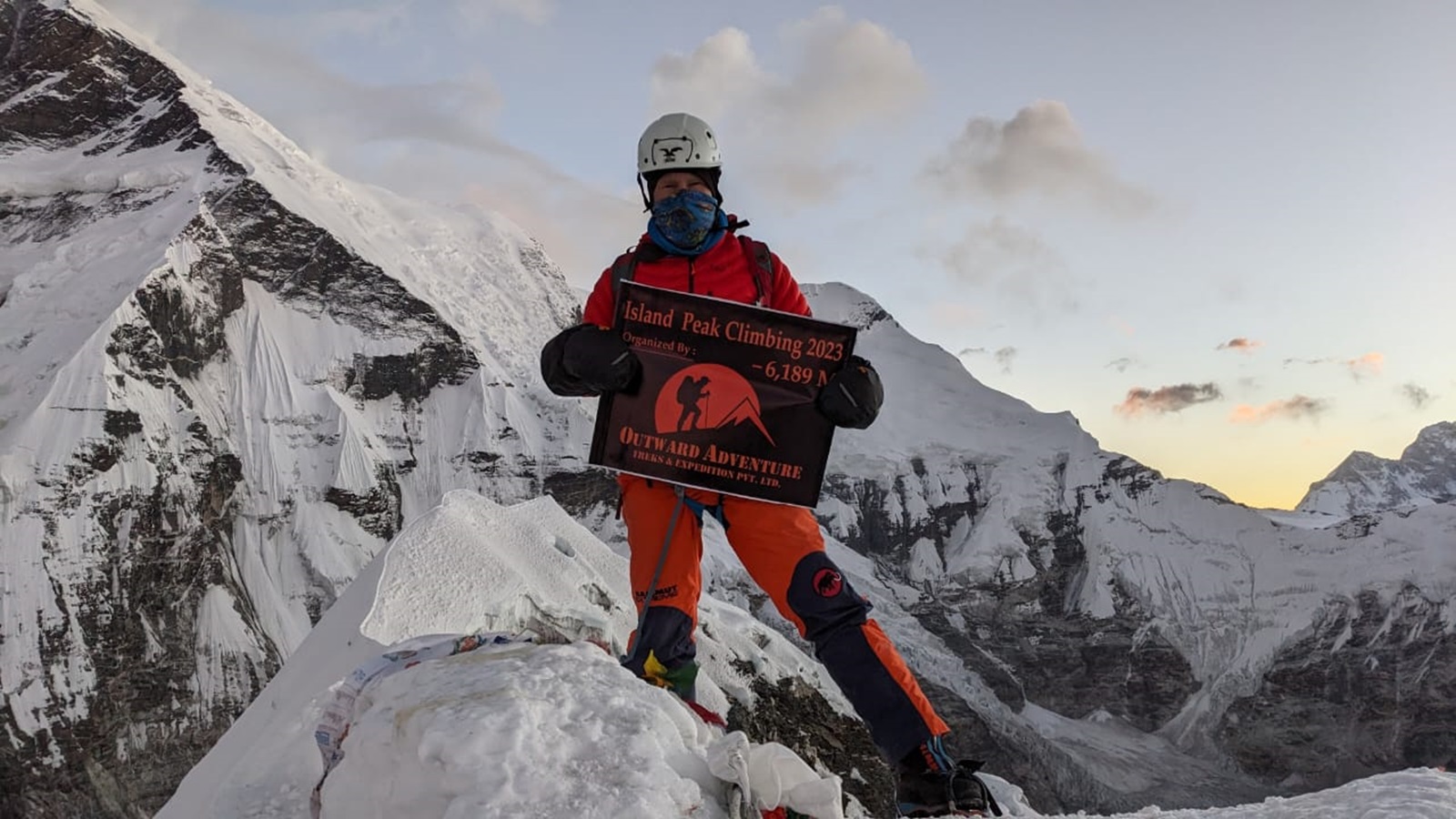
Island Peak follows the classic Everest Base Camp approach through Phakding, Namche Bazaar, Tengboche, and Dingboche. After acclimatizing, climbers divert east toward Chhukung and Island Peak Base Camp (5,200 m).
The climb itself includes crossing crevasses, using fixed ropes, ascending an icy headwall of 45–50 degrees, and traversing a narrow summit ridge. Strong rope management and confidence with crampons and jumars are essential.
| Aspect | Mera Peak | Island Peak |
| Elevation | 6,476 m | 6,189 m |
| Technicality | Low | Moderate (2B grade) |
| Key Challenge | Endurance & altitude | Ice headwall & rope work |
| Equipment Use | Basic crampons & ice axe | Fixed rope, jumar, rappel |
| Recommended Experience | High-altitude trekking | Basic mountaineering training |
Verdict:
Choose Mera Peak for a high-altitude endurance challenge with minimal technical exposure.
Choose Island Peak for hands-on mountaineering practice and rope experience.

For Mera Peak: Build cardiovascular endurance and leg strength for multi-day high-altitude trekking. Simulate long hikes with heavy packs and stair climbs.
For Island Peak: Add technical skills—rope ascents, abseiling, crampon and ice-axe handling. A short alpine-training course is beneficial.
General Preparation: Train 4–6 months in advance with cardio, strength, and mental conditioning. Acclimatization days are non-negotiable.
Nepal’s Himalayas offer two stable climbing windows:
| Season | Months | Conditions |
| Spring | March–May | Clear skies, moderate temperatures, flowering forests; busier trails. |
| Autumn | Mid-Sept–Nov | Dry, crisp air after monsoon; best visibility; colder nights. |
Island Peak: Follows Everest’s weather pattern. Spring brings vibrant scenery and crowded teahouses; autumn gives exceptional clarity.
Mera Peak: Slightly colder due to higher altitude, but autumn offers unparalleled summit views of five 8,000-meter giants.
Avoid winter (Dec–Feb) and monsoon (June–Aug) because of extreme cold or unstable weather.
Both peaks require authorization from the Nepal Mountaineering Association (NMA) and relevant park permits.
| Permit | Mera Peak | Island Peak | Cost (USD approx.) |
| NMA Group B Climbing Permit | ✔ | ✔ | $250 (Spring), $125 (Autumn), $70 (Winter/Summer) |
| National Park Entry | Makalu Barun NP Permit | Sagarmatha NP Permit | NPR 3,000 (≈ $25) |
| Local Area Permit | Khumbu Pasang Lhamu Rural Permit | Same permit for Khumbu region | NPR 2,000 (≈ $17) |
| Garbage Deposit (Refundable) | ✔ | ✔ | $500 per team |
Permits must be obtained via a licensed Nepali trekking agency. Individual applications are not allowed. The agency also manages logistics, guides, and the refundable waste-management deposit.
Island Peak:
Uses the Everest Base Camp trail, where teahouses are well-developed. You’ll find a wide range of meals—Dal Bhat, pasta, pancakes, and even pizza. Most lodges offer hot showers, Wi-Fi, and charge a small fee.
At Base Camp and High Camp, you’ll shift to tented accommodation supported by a kitchen crew.
Mera Peak:
The Hinku Valley route is more remote. Teahouses are simpler, food options limited, and electricity scarce. Beyond Khare, all stays are in tents. This remoteness adds to the sense of true Himalayan wilderness.

| Peak | Avg. Success Rate | Primary Limiting Factor |
| Mera Peak | 80–90 % (with good acclimatization) | Altitude & weather |
Mera Peak’s gradual acclimatization profile favors higher completion rates. Island Peak’s technical headwall filters out climbers lacking rope confidence or stamina.
Regardless of choice, slow ascent and extra rest days remain the strongest predictors of success.
Travel insurance covering high-altitude rescue (above 6,000 m) is mandatory. Helicopter evacuation can exceed $10,000 USD. Verify that your policy includes:
Safety Essentials:
| Component |
Mera Peak | Island Peak |
| Typical Duration | 18–20 days | 16–18 days |
| Average Total Cost (USD) | 2,000–2,500 | 1,800–2,300 |
| Group Size | 2–10 climbers | 2–12 climbers |
| Guide & Porter Support | Full package required | Full package required |
Island Peak teaches technique: rope handling, glacier safety, and teamwork under pressure.
Mera Peak teaches resilience: managing altitude, pacing yourself, and maintaining focus through long hours of solitude.
Both reward climbers with unmatched Himalayan panoramas and a sense of achievement few adventures can equal.
| If You Prefer | Choose This Peak |
| Higher altitude and remote setting | Mera Peak |
| Technical rope work and steeper climb | Island Peak |
| Quieter trails and endurance test | Mera Peak |
| Cultural interaction and comfort | Island Peak |
| First experience of mountaineering | Either, depending on focus (altitude vs technique) |
At the expert level of guidance and safety, Outward Adventure Treks & Expeditions, a government-licensed trekking and mountaineering agency based in Kathmandu, provides professional logistics, certified guides, and full-service expeditions for both peaks. With years of Himalayan field experience, our team ensures every climber receives reliable information, ethical support, and the highest safety standards from arrival to summit and back.
 Jul 26, 2026
The Annapurna Circuit Trek is widely recognized as one of the world's greatest trekking adventures, offering an extraord...
Read More Jul 21, 2026
Standing at 6,476 meters (21,247 ft), Mera Peak is Nepal's highest trekking peak and one of the world's most rewarding h...
Read More Jul 14, 2026
Planning a Himalayan adventure in 2027? Everest Base Camp vs Annapurna Base Camp Trek is one of the most searched compar...
Read More Jul 09, 2026
Planning your 2027 Island Peak and Everest Base Camp Trek is your opportunity to experience two of Nepal's most iconic H...
Read More
Leave a Comment